Freedom Wall Analytics 2026
What a freedom wall is
If you did not go to school in the Philippines, you might not know what a freedom wall is. These are anonymous confession pages, usually on Facebook, where students post whatever they are thinking about their school, their lives, and each other without attaching their names. They are everywhere here, and I had spent time on them myself, so I already understood how ordinary and revealing those spaces could feel at the same time.
The question behind the thesis
What made me curious was a pattern I kept seeing. Students would post real, specific complaints about their school on a freedom wall, the kind of thing they might normally take to an office, and I kept wondering why they chose to say it there instead of reporting it directly. I also noticed how open people became about their mental health once they were anonymous. Something honest was happening in these spaces, but almost nobody had looked at it at scale. That became the question behind my thesis.
From research to a working tool
The thesis ran in two parts. Thesis 1 was the groundwork, covering the proposal, methodology, and literature review. That review became a result of its own when we used the TCCM framework to publish it in MJSIR, which meant that part of the research reached a journal before the tool even existed. We also defended the full thesis successfully.
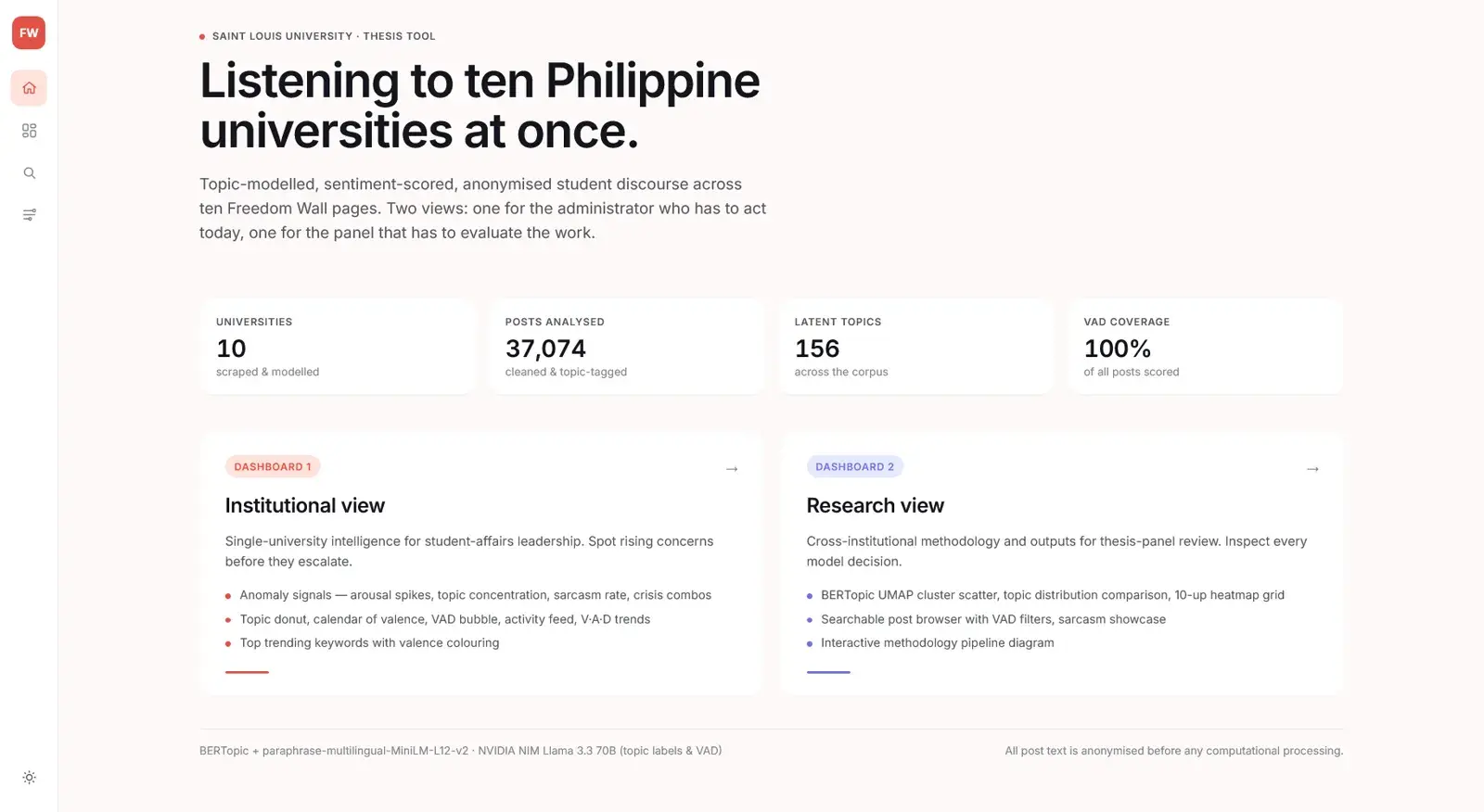
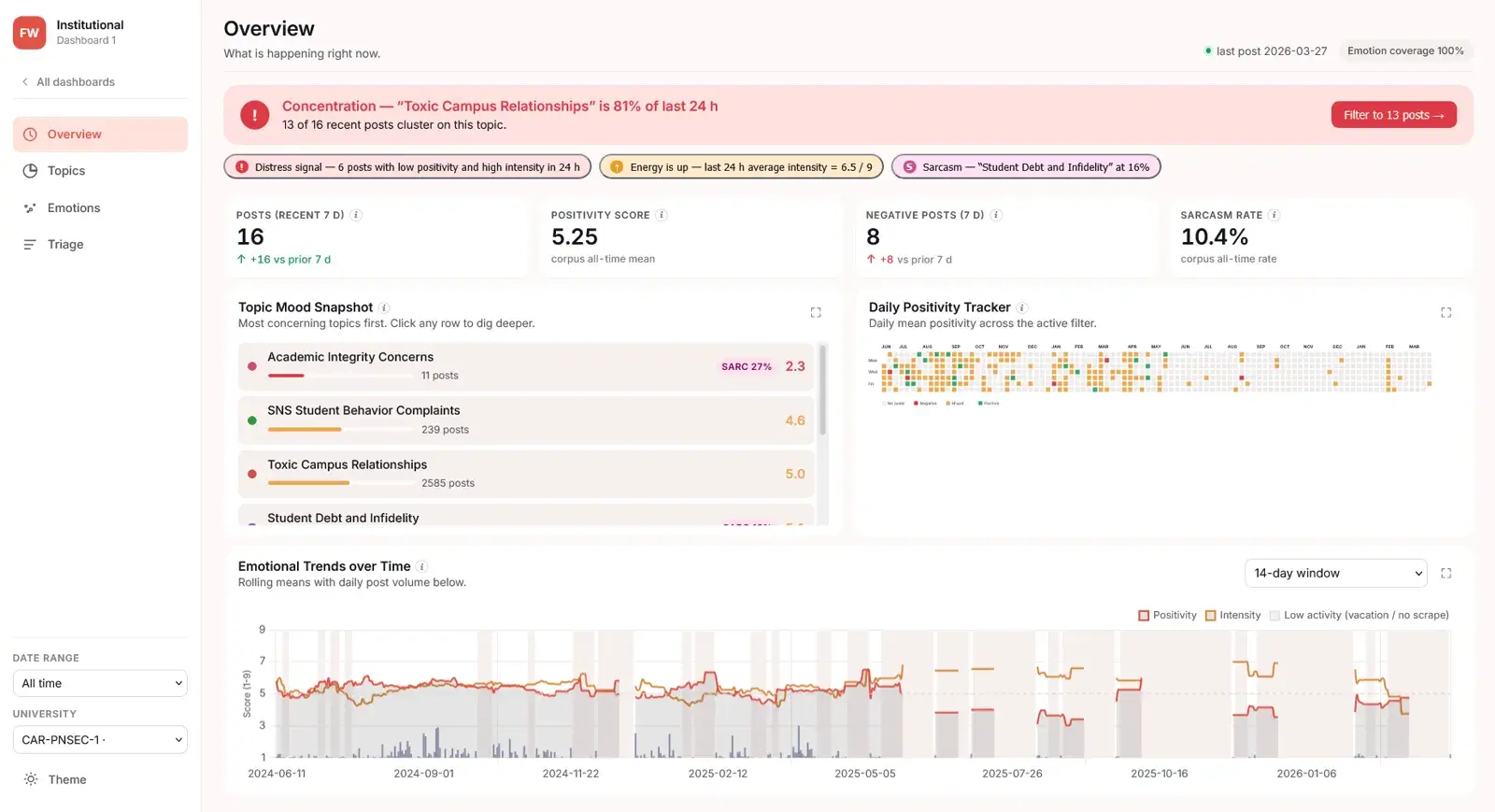
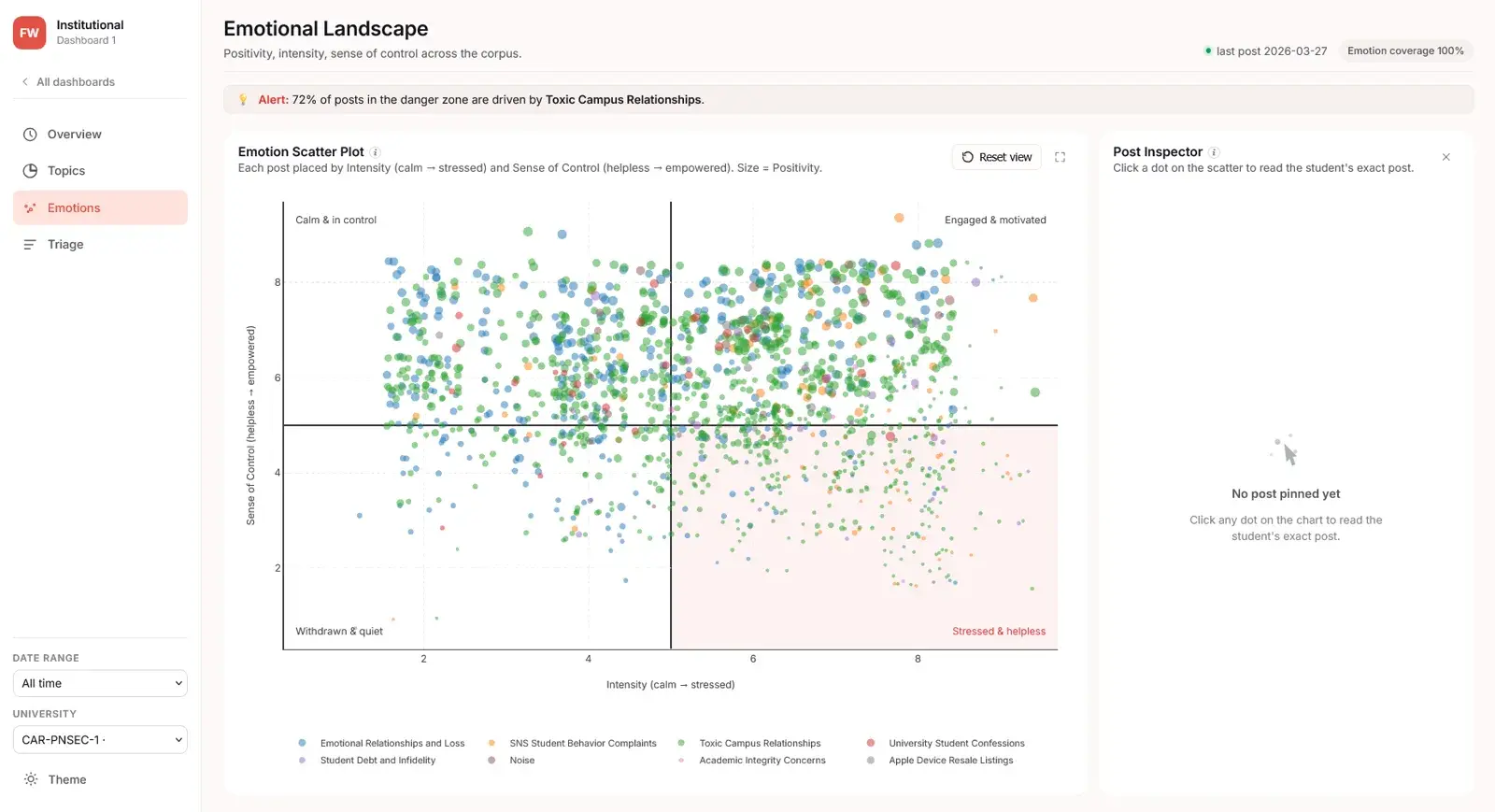
Thesis 2 was the work of building the actual tool. I wrote a Playwright scraper to collect the posts and anonymized everything afterward because this is real student data, and that part was non-negotiable. The rest became a pipeline: BERTopic with XLM-RoBERTa embeddings to identify what people were talking about, Llama 3.3 70B to score the emotion behind each post, and UMAP with HDBSCAN to cluster the results. All of that feeds a dashboard with two views. I am proudest of the scraper, while the hardest part was cleaning the text because Filipino student slang, abbreviations, and school-specific words kept getting dropped, and checking the language model's output took real patience.
What students were saying
So what did students actually say? A large share of the posts were confessions, which is what you might expect, but another major group focused on how students felt about their own schools, and most of that sentiment was negative. The balance changed by university. Some walls were mostly personal, while others leaned heavily into complaints about the institution. The anonymity was doing exactly what I thought it might do: making people more willing to say what they would not say with their names attached.
A team thesis I drove
This was a team thesis, but I drove it. I was the lead, the main developer, and the main writer, and it was my idea from the beginning. I archived the dataset publicly on Zenodo in fully anonymized form so the work could be reproduced. The raw data cannot live in the GitHub repository for legal reasons, even after anonymization, but the engine and dashboard are both there. If you want to understand how it works, you can run it yourself.